A close friend of mine, a senior engineering director from Powai, spent his entire Sunday scrolling through Facebook Marketplace and classifieds apps. By evening, he called me with pure triumph in his voice. He had spotted an acre of land overlooking a misty valley for the price of a mid-size hatchback, complete with a tiny photo of a water body and a phone number scribbled in MS Paint. When we drove down along National Highway 160 to see it in person, the reality hit us squarely in the face. The breathtaking valley view existed, but the plot sat inside an unapproved agricultural green zone with zero road access, three disputed cousins on the 7/12 extract, and a village electric line running across someone else’s private farmland.

Finding authentic, verified NA plots Igatpuri buyers can trust without sleepless nights has become an exercise in separating glossy digital claims from hard legal reality. In Maharashtra, anyone with a smartphone can post a real estate listing on social media or classified boards. Very few of those posters possess clear non-agricultural conversion titles, sanctioned layout approvals, or registered development rights. Shree Venkatesh Nagar developed its presence across 4 decades of trust in the Sahyadri hills, and in our work at the property, we witness weekly how innocent families get trapped by unverified listings. If you are shopping for land for a weekend home or a secondary residence, here is the exact reality behind those online bargains, and how to protect your family’s hard-earned capital.
The anatomy of a viral plot listing on classifieds
Classified listings on OLX and social feeds on Facebook work on human emotion. They show you a pristine mountain mist, morning dew on lemongrass, and a price tag that looks like a clerical error. What they do not show you is the land registry records behind that boundary line.
Most individual classified listings fall into three distinct categories. The first is raw agricultural land that someone claims will convert automatically into residential status. Under the Maharashtra Land Revenue Code 1966, agricultural land never converts on autopilot. The second category is guntha plotting, where an ancestral farmland parcel gets carved into tiny rectangles with chalk powder, sold on unregistered stamp papers without any Town Planning sanction. The third category is joint-family agricultural property where four brothers agreed to sell, but two uncles and a sister who moved to Pune have not signed the consent deed.
When an online seller writes clear title in their caption, it usually means nobody has filed an active police complaint this calendar month. It does not mean a district collector signed a final conversion order. If a listing seems strangely underpriced compared to standard market benchmarks in the taluka, you are not finding an insider secret. You are looking at an unregularized risk.
The non-agricultural conversion paper trail explained
In Maharashtra, real estate ownership is not defined by a physical fence or a cheerful video tour. It is defined by government revenue entries. Before you transfer a single rupee as token money for any parcel in the Sahyadri hills, you must inspect the actual statutory trail.
According to data published by the Department of Registration and Stamps Maharashtra, title disputes constitute over 60% of rural land litigation in developing peri-urban belts. A legal layout requires a Collector NA Order (Non-Agricultural Order) issued by the competent district authority, specifically granting permission for residential development. Many classified ads showcase a commercial poultry permission, a farmhouse permission, or a temporary non-agricultural application receipt, passing it off as full residential NA. Those documents do not give you the right to construct a residential bungalow.
You must also examine the 7/12 extract (Saat Baara Utara). Pay strict attention to the Pherphar (mutation entries) and the second page showing encumbrances. In our work at Shree Venkatesh Nagar, we insist that prospective buyers inspect the 30-year search report prepared by an independent title advocate. If the seller on a social media app stalls when you ask for the mutation history, walk away immediately. For a deeper breakdown of these statutory documents, review our guide on 7/12 extract, NA order, and paperwork in Igatpuri to understand how revenue entries operate.
The hidden trap of Gram Panchayat permissions
Online classified sellers love to wave a sheet of Gram Panchayat letterhead in front of buyers. They speak with immense confidence, pointing to a local sarpanch signature and an official rubber stamp. They claim this letter represents complete building sanction.
This is one of the most expensive misunderstandings in rural property purchases. A Gram Panchayat holds no statutory authority to convert agricultural land or sanction high-density residential layouts. Only the Town Planning Department and the District Collector hold legal sanctioning powers for land use conversion. When an unapproved layout gets created on agricultural soil, the local panchayat may issue an assessment entry in their local tax register (Form 8 or Namuna 8). That tax entry merely records tax collection; it does not confer legal building permissions.
Buying a plot on informal panchayat papers leaves your home permanently exposed to demolition notices, water connection rejections, and zero utility meters. Banks also run rigorous legal checks. If a layout lacks town planning sanction, nationalized and private scheduled commercial banks will flatly deny mortgage support. Before committing funds, read our detailed comparison on Gram Panchayat land versus NA plot rules in Igatpuri to see why these informal plots cost families lakhs in retroactive regularizations.
Why RERA registration changes the entire ownership equation
The Real Estate (Regulation and Development) Act, known as MahaRERA in Maharashtra, established clear boundary lines between organized developers and fly-by-night brokers. You will almost never see a classified listing on Facebook cite an active MahaRERA registration number.
Why do classified sellers avoid MahaRERA? Because registration demands full transparency. A developer must upload certified title ownership documents, encumbrance certificates, approved layout maps, town planning permissions, project completion timelines, and designated escrow accounts. When you buy an unverified plot from an ad, you bear 100% of the project completion risk. If the seller promised a tar road, a water pipeline, and a security cabin, but vanishes after taking your registration payment, you have no formal regulatory recourse except filing a protracted civil lawsuit.
Within a MahaRERA-registered gated community, development obligations are legally binding covenants. The internal asphalt roads, drainage systems, electricity transformer sanctions, and environmental clearances are committed on government public records. If you are comparing plot purchases versus finished residential options like our Rosewood Apartments or our custom bespoke villas, verified regulatory standing ensures that your property title remains completely clean for your heirs.
Physical infrastructure: what is on the ground versus what is in the caption
When you read a social media classified post, words like road touch, water available, and electricity nearby appear in almost every listing. Let us translate what those phrases mean in practice on unverified plots.
Road touch often means the owner has an informal understanding with an adjacent farmer to drive across his paddy field during dry months. The moment monsoon arrives, that dirt track turns into slush, or the neighbor builds a stone wall, cutting off your physical entry entirely. Electricity nearby often means an agricultural high-tension wire passes two kilometers away, requiring you to pay ₹4,00,000 to ₹7,00,000 out of pocket to Maharashtra State Electricity Distribution Company Limited (MSEDCL) for private poles and a step-down transformer. Water available means you are permitted to drill a borewell at your own expense, with no guarantee of hitting groundwater in hard basalt terrain.
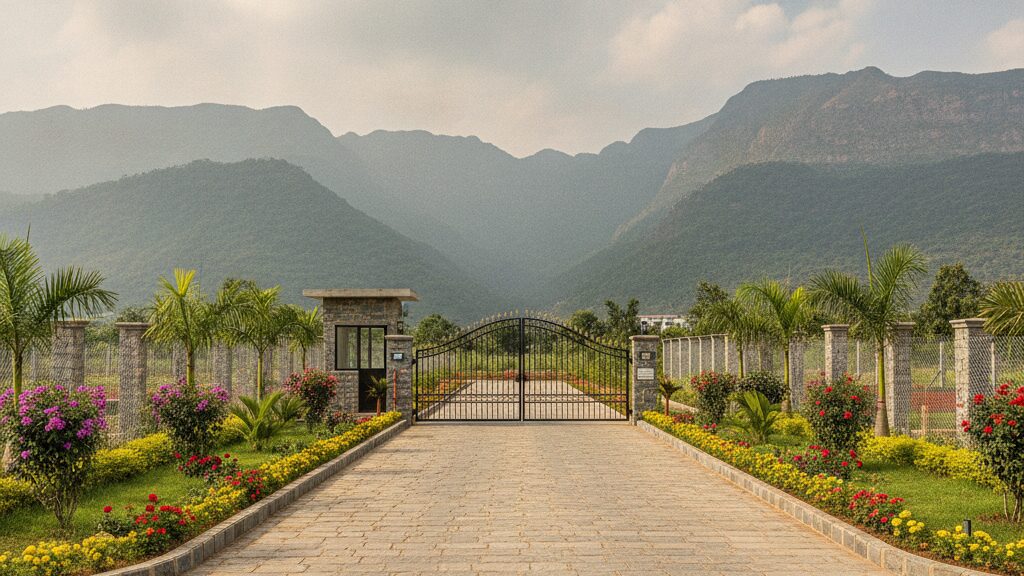
Within an established gated community like Shree Venkatesh Nagar, physical infrastructure is completely delivered prior to handover. That includes:
- Demarcated plot boundaries with permanent boundary stones and internal compound lines
- Direct motorable access via wide internal paved roads connected to municipal access roads
- Underground water distribution networks connected to dedicated storage tanks
- Underground electricity cabling with individual meter points sanctioned by MSEDCL
- Stormwater drainage systems engineered for heavy Sahyadri monsoon runoffs
- Round-the-clock physical security teams, gated entry barriers, and perimeter surveillance
Without this infrastructure in place, building a weekend home becomes an exhausting administrative headache. You end up spending your weekends chasing local water tankers and diesel generator mechanics instead of enjoying nature trails and fresh mountain air.
The due diligence checklist every land buyer must follow
Whether you choose to purchase your land at Shree Venkatesh Nagar or through another seller in Nashik district, you should treat the acquisition with formal diligence. Never let an emotional valley view cloud your legal judgment. Demand the following paper trail from any seller before signing an agreement to sale:
- Registered Title Deed: Trace ownership back 30 years to confirm an unbroken chain of ownership without gaps or unverified family partitions.
- Collector NA Sanction Order: Verify that the document specifies residential use and covers the specific survey and gut numbers you are purchasing.
- Final Sanctioned Layout Plan: Check that the layout bears the official seal of the Town Planning Department, showing designated open spaces, internal roads, and amenity plots.
- Latest 7/12 Extract: Obtain an online digital extract from the Maharashtra government portal (Mahabhulekh) to confirm zero unrecorded mortgages, court stays, or tenancy claims.
- Non-Encumbrance Certificate: Secure a certified certificate issued by the Sub-Registrar of Assurances covering a minimum period of 12 to 30 years.
- Demarcation Certificate (Mojni Map): Insist on an official land measurement map issued by the Taluka Inspector of Land Records (TILR) verifying physical boundaries.
- Bank Approval Letters: Ask if tier-one banks have vetted the layout. Nationalized lenders do not approve project files with missing permissions.
If you plan to finance your purchase through institutional mortgages, consult our practical guide on NA plot home loans in Igatpuri to understand bank eligibility criteria and interest structures.
The hidden financial drain of unverified land deals
Many urban buyers assume that purchasing raw land via classified platforms saves them money. On the surface, paying ₹600 per square foot for an unorganized plot looks like a steal compared to paying for a fully developed plot inside an organized community. But real estate math requires you to calculate total cost to occupancy.
When you buy an unorganized plot, you must pay for private land measurement surveys, hire lawyers to fight mutation delays, construct private boundary walls to prevent boundary encroachment, pay for private electricity poles, and drill uncertain borewells. According to property valuation data across Maharashtra second-home micro-markets, individual buyers in unorganized layouts spend between ₹450 and ₹800 additional per square foot simply to bring basic road access, electrical connections, and boundary protections to their site.
Worse, the appreciation rate of an unorganized plot remains depressed. Future buyers from Mumbai and Nashik increasingly demand gated security, clubhouse facilities, and legal certainty. When you decide to exit, an unverified plot sits on the market for years. For an empirical look at returns across the region, read our analysis on NA plots versus apartments in Igatpuri.
The Shree Venkatesh Nagar difference: building a multi-generational legacy
Land ownership in the Sahyadri hills should be an emotional sanctuary, not an endless legal headache. When families choose to build their second home at Shree Venkatesh Nagar, they are buying into a four-decade history of land development integrity.
Our gated community offers clear-title, collector-sanctioned residential NA plots nestled amid serene mountain vistas, walking paths, and peaceful nature trails. We handle the entire bureaucratic process: title verification, town planning layouts, environmental compliance, and permanent infrastructure delivery. You receive a clearly demarcated plot inside a secure, staffed perimeter where your family can experience a true digital detox away from concrete urban environments.
Whether you choose to keep your land as a wealth-preserving asset, build a custom holiday home, or explore our flexible construction pathways alongside bespoke villas or Rosewood Apartments, you own a verifiable real estate asset that passes seamlessly to your children. Take the time to understand our founding philosophy by exploring our four-decade story in the region.
Frequently Asked Questions
What does an NA plot in Igatpuri mean?
An NA plot is a parcel of land officially converted from agricultural use to residential non-agricultural use by district authorities. This legal conversion allows the owner to construct a residential bungalow without violating state land revenue laws.
Can I build a house on Gram Panchayat land in Igatpuri?
You cannot legally construct a residential home on Gram Panchayat land without Town Planning approval and a Collector NA order. Panchayat tax assessment entries do not confer legal building sanctions in Maharashtra.
How do I verify if an Igatpuri plot has a clear title?
You verify title by examining the 30-year search report, latest 7/12 extract, mutation entries, and the Non-Encumbrance Certificate from the Sub-Registrar. Hiring an independent real estate advocate ensures all historical ownership transfers were lawful.
Are plots advertised on OLX and Facebook legally safe?
Most classified listings on social platforms lack proper Town Planning sanctions, NA orders, or clear title documentation. Buyers must conduct exhaustive legal due diligence and never pay advance tokens without verifying physical land records.
Does MahaRERA apply to plotted land developments?
Yes, any plotted layout exceeding 500 square meters or more than eight individual plots falls under mandatory MahaRERA registration. Registered projects provide legal protection against false marketing claims and project delays.
Can banks provide loans for unverified plots in Maharashtra?
Commercial banks strictly decline home and plot loans for layouts lacking Town Planning approval or Collector NA sanctions. They only lend against projects with clean 30-year titles and approved revenue layouts.
What is the difference between agricultural land and residential NA plots?
Agricultural land can only be owned by certified farmers and used for farming activities under Maharashtra state law. Residential NA land permits any Indian citizen to purchase the property and build a residential structure.
Why should I buy a plot in a gated community instead of standalone land?
A gated community provides complete title security, round-the-clock physical protection, paved road connectivity, and uninterrupted water and power utilities. Standalone unorganized plots leave owners vulnerable to boundary encroachment and expensive private utility installation costs.
Secure your family’s retreat in the Sahyadri hills
Stop risking your savings on anonymous online classifieds with missing documents and unverifiable claims. Connect directly with the development team at Shree Venkatesh Nagar to inspect fully approved, Collector-sanctioned NA plots with complete title documentation and transparent legal records.
Book your private, no-obligation site visit today and experience the natural tranquility of Igatpuri firsthand. Our advisory team will guide you through our complete legal dossier and help you select the ideal setting for your family’s holiday retreat.