The real cost of utilities in the Sahyadri hills
Buying land in the hills feels romantic until you try to turn on a geyser on a cold Sunday morning and realize there is no power. Igatpuri infrastructure water electricity reality hits hard when you discover that your scenic plot does not have a municipal tap or an active electricity pole within 500 meters. Before you buy an acre of farmland or an isolated parcel of land, you need to know what building off-grid actually demands.
In our work at Shree Venkatesh Nagar, backed by 4 decades of trust in the region, we have watched buyers spend lakhs fixing basic utility mistakes. Getting water and electricity to a plot in Igatpuri requires dealing with hard Sahyadri basalt, state electricity distribution protocols, and steep seasonal changes. Building your bespoke villas or weekend home requires clear planning for water storage, independent backup power, and local sanctions before laying a single foundation stone.
Water sources in Igatpuri: municipal lines versus private borewells
Igatpuri receives over 3,000 millimeters of rainfall every monsoon, yet water scarcity during March, April, and May is common. The geology of the Sahyadri hills features thick layers of hard volcanic basalt rock, which means groundwater does not collect in soft, sandy aquifers. When rain stops in October, the runoff drains rapidly down the mountain slopes toward the dams.
Municipal water from the Maharashtra Jeevan Pradhikaran (MJP) or the local municipal council supplies established town zones and certain approved development sectors. If your land sits within these boundaries, you apply for a sanctioned domestic connection. Outside municipal limits, standalone plots rely entirely on Gram Panchayat supply schemes, which run on limited schedules, often releasing water once every two or three days for two hours.
If you purchase standalone Gram Panchayat land vs NA plot, you must depend on a private borewell. Drilling a borewell in Igatpuri requires drilling through 150 to 350 feet of hard basalt rock. The cost runs around ₹350 to ₹450 per foot including casing pipes, bringing a standard 300-foot borewell to roughly ₹1,20,000 before pump installation. The failure mode here is seasonal depletion: a borewell that yields five inches of water in November can drop to a trickle by late April. In gated projects with sanctioned NA plots in Igatpuri, developers build centralized community storage reservoirs and multi-source supply lines, which shields individual owners from the cost of dry summer borewells.
Designing rainwater harvesting and long-term storage
Relying on a single water source in a hill station is a mistake. The standard requirement for a family of four spending a weekend at a second home is 600 liters per day. If you host guests or run landscaped gardens, that consumption rises to 1,500 liters per day. You need minimum on-site storage capacity for seven days of continuous supply.
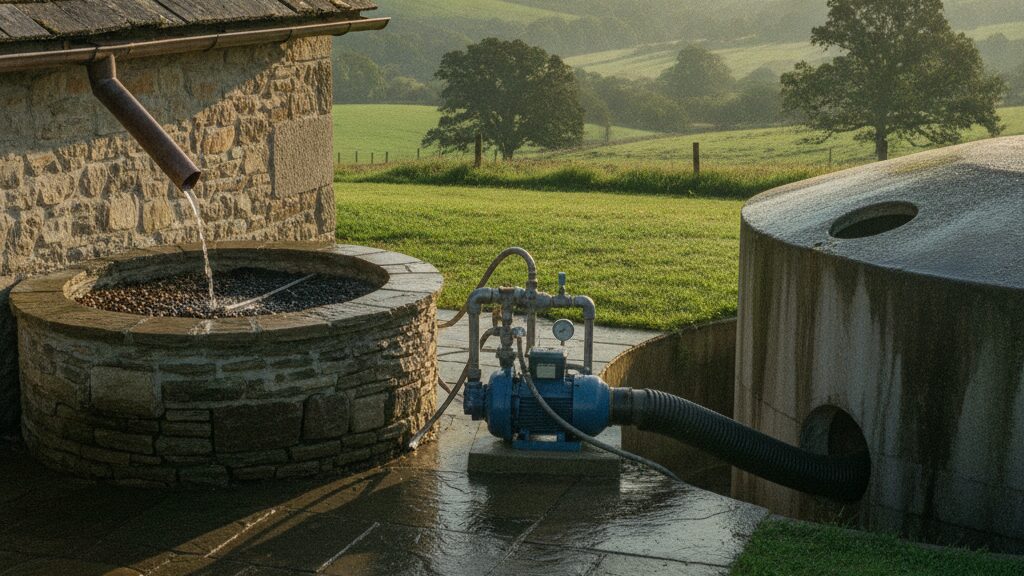
Your property design must include dual-tank architecture: an underground water sump made of reinforced cement concrete (RCC) and an overhead tank. Underground storage keeps water cool and prevents algae growth during sunny weeks. An RCC sump of 10,000-liter capacity costs approximately ₹1,50,000 to construct, including waterproofing treatments. Overhead tanks should hold at least 2,000 liters, using triple-layer UV-stabilized polyethylene tanks to withstand high-altitude sun exposure.
Rainwater harvesting is mandatory for non-agricultural developments under Maharashtra town planning rules, but it is also practical survival engineering. Igatpuri’s heavy monsoon allows a 2,000-square-foot roof to capture over 5,00,000 liters of pristine rainwater between June and September. By routing your roof gutters through a basic sand-and-gravel filter into your storage sump, and sending the overflow into a dedicated recharge pit near your borewell, you recharge the surrounding sub-surface water table. That recharge keeps your private borewell producing water throughout the dry months.
Electricity in the hills: MSEDCL reality and voltage drops
Power distribution across the taluka falls under the Maharashtra State Electricity Distribution Company Limited (MSEDCL). While main town arteries stay lit, feeder lines running toward rural hills face regular disruptions, especially during monsoon thunderstorms and scheduled maintenance days. The real challenge for a luxury weekend home is not total blackout; it is severe voltage fluctuation.
Rural distribution lines often experience voltage dips down to 160 volts or surges spiking past 280 volts. These swings destroy modern inverter air conditioners, water pumps, and electronic control boards. When you build a villa, installing a mainline servo stabilizer at the primary distribution board is essential. A 10 kVA digital mainline stabilizer costs roughly ₹45,000 to ₹65,000, and it preserves your appliances across erratic line conditions.
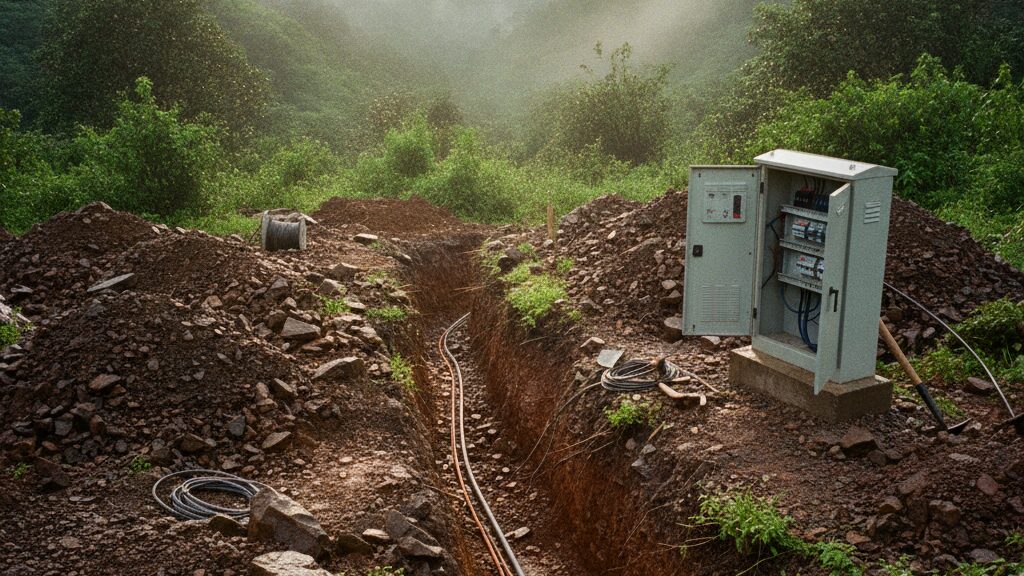
Getting a fresh low-tension (LT) domestic connection from MSEDCL on raw land demands patience. You must submit your 7/12 extract, sanctioned building plan, ownership deed, and an application through the Mahavitaran web portal. If the nearest operational distribution transformer is more than 100 meters away, MSEDCL requires you to pay for electric poles, conductor wires, and labor. In some cases, you must sponsor an entire distribution transformer, which adds anywhere between ₹2,50,000 and ₹5,00,000 to your initial site expenses before you switch on a single light bulb.
Evaluating power backup: inverters, diesel generators, and solar setups
A weekend retreat should be a haven for true digital detox and rest, not a study in managing candle supplies. Planning your energy backup depends on how frequently you reside on the property and how many high-load appliances you operate simultaneously.
A standard battery inverter works well for short city outages, but it struggles with 12-hour rural breakdowns. Traditional tubular lead-acid batteries degrade quickly if discharged repeatedly during prolonged power cuts. A modern lithium-ferro-phosphate (LFP) inverter system provides faster charging, deeper discharge cycles, and a lifespan exceeding 10 years. A 5 kVA LFP system runs lights, fans, televisions, Wi-Fi routers, and a refrigerator comfortably for eight hours, costing around ₹1,80,000.
For heavy loads like water heaters, air conditioning, and deep borewell submersible pumps, a silent diesel generator (DG) set remains the primary workhorse. A 10 kVA soundproof diesel generator costs between ₹2,20,000 and ₹3,000,000. It requires regular exercise runs every fortnight to prevent fuel injectors from clogging, along with dedicated diesel storage compliance. Alternatively, hybrid rooftop solar installations have emerged as the most reliable investment. An on-grid solar system with battery storage powers your home during day-long outages and lowers your monthly power bills. With net metering sanctioned by MSEDCL, your unused generation flows back into the grid, turning your summer roof into a financial credit.
What is included in sanctioned NA plots versus unorganized land
The gap between raw land and fully developed non-agricultural plots catches many city buyers off guard. Unregistered brokers selling open plots rarely mention that the attractive price tag excludes the entire utility infrastructure. You end up spending months chasing local contractors and government departments just to bring wires and pipes to your gate.
To understand what you receive versus what you must build yourself, look at the infrastructural breakdown before signing an agreement:
- Individual low-tension power cables routed underground to your boundary line with pre-installed distribution feeder pillars
- Direct piped potable water lines terminating inside your plot demarcation with an independent water meter
- Wide internal tar or concrete roads designed with integrated stormwater drainage gutters to handle Sahyadri runoff
- Perimeter boundary walls with controlled security checkpoints to protect electrical meters and water valves from tampering
- Dedicated common transformer yards certified by the electrical inspectorate
- Centralized overhead and underground water reservoirs managed by community maintenance teams
When you purchase unorganized land, every one of these items falls on your personal budget and schedule. You must negotiate right-of-way permissions with neighboring landowners to lay underground water pipelines or plant electricity poles. If a neighbor denies right-of-way across their boundary, your plot remains disconnected. In contrast, fully compliant projects like SVN verified NA plots come with pre-sanctioned utility corridors, sparing you from bureaucratic delays and civil litigation.
Utility checklist for building your weekend villa
If you have already purchased your plot or are preparing to construct, you need an operational roadmap. Executing utility setup in a hill station requires staging your work around the weather. The monsoon months between June and September halt excavation and concrete curing, meaning all underground infrastructure must finish before the rains begin.
Follow these practical construction milestones to avoid utility failures:
- Commission an electrical load study based on total planned tonnage for air conditioning, geysers, pumps, and electric vehicle charging points
- Apply for a commercial temporary construction power meter before starting excavation to avoid hefty penalties from electricity inspectors
- Test borewell water quality through an accredited laboratory to check for total dissolved solids (TDS), hardness, and bacterial presence before designing your domestic filtration
- Install dual-plumbing lines inside the villa structure so treated greywater from bathrooms can irrigate gardens without touching drinking supplies
- Build a concrete encasement around all exterior electrical cables to prevent rodents from chewing lines inside soil trenches
- Install lightning arresters on the highest roof parapet to safeguard connected home electronics from severe Sahyadri mountain lightning strikes
Securing clear documentation is just as vital as laying physical pipes. Review the legal prerequisites in our guide to 7/12 extract and NA plot paperwork before releasing funds for utility installations. Knowing that your land holds sanctioned status gives you statutory rights to municipal services and power grid hookups.
Maintenance costs and community living
Operating an independent house in an isolated rural pocket requires continuous maintenance. When you live in Mumbai or Nashik during the week, you cannot drive up on a Wednesday just because a water valve burst or a transformer fuse tripped. Maintaining isolated off-grid infrastructure requires hiring a full-time local caretaker, which adds ₹15,000 to ₹20,000 every month in recurring overheads.
This is why buyers seeking a hassle-free lifestyle prefer an organized gated community. Shared infrastructure spreads the recurring costs of water pump maintenance, electrical transformer servicing, security personnel, and generator diesel over dozens of owners. Instead of paying for dedicated technicians, you pay a predictable monthly association maintenance charge.
For buyers who want hill station living without managing independent pumps, water tanks, or private generators, residential properties like Rosewood Apartments present an ideal alternative. You enjoy the brisk climate, mountain views, and nature trails of the region while professional facility management teams maintain uninterrupted water pressure and round-the-clock power backup. If your goal is building a custom family residence, building on ready-to-construct plots inside our gated township lets you focus on architectural finishes while our foundational infrastructure supplies the essential utilities from day one.
Frequently Asked Questions
Can I dig a borewell anywhere on my plot in Igatpuri?
You can dig a borewell subject to local groundwater authority guidelines and safe distances from septic drain fields. Hydro-geological surveys help pinpoint fracture zones in the basalt rock to avoid drilling expensive dry holes.
How reliable is MSEDCL power supply in Igatpuri?
Main lines are relatively stable, but peripheral rural feeders experience outages during monsoon storms and weekly maintenance windows. Installing an inverter or backup generator system is necessary for comfortable second home living.
What is the average cost to bring electricity to an unserviced plot?
Bringing electricity from a distant line can cost between ₹1,50,000 and ₹5,00,000 depending on the number of poles and transformer capacity required. Gated developments absorb this cost by delivering active feeder points directly to your plot boundary.
Is borewell water in Igatpuri safe for drinking?
Basalt rock water is generally low in heavy chemicals but often contains dissolved minerals and seasonal surface runoff sediments. Installing an RO and UV water purification system ensures safe drinking water year-round.
Do I need permission to install rooftop solar in Igatpuri?
Off-grid solar setups require no permits, but grid-tied systems must receive net-metering sanctions from MSEDCL. Sanctioned solar installations let you export excess day generation to offset baseline consumption costs.
What size underground water tank should I build for a 3 BHK villa?
A 3 BHK weekend villa requires an underground storage capacity of at least 8,000 to 10,000 liters. This volume provides uninterrupted water for a full family gathering over an extended four-day holiday weekend.
Who manages utility repairs in an organized gated community?
A central facility management team monitors common transformers, water pump stations, filtration units, and security systems. Individual plot owners pay a standard maintenance fee rather than troubleshooting utility breakdowns personally.
Why do builders in Igatpuri recommend rainwater harvesting systems?
Igatpuri receives heavy seasonal downpours that can easily recharge local groundwater levels through structured collection pits. Recharging your borewell during monsoon guarantees reliable water yields throughout the hot summer months.
Secure your ready-to-build plot with fully developed utilities
Avoid the stress of digging dry borewells, paying for private electricity transformers, and untangling rural red tape. Explore verified NA plots and ready homes with completed water and power connections at Shree Venkatesh Nagar. Schedule your private site tour today with zero obligation, and let our team show you how four decades of community development create the perfect foundation for your family legacy.