The bottom line on second home taxes
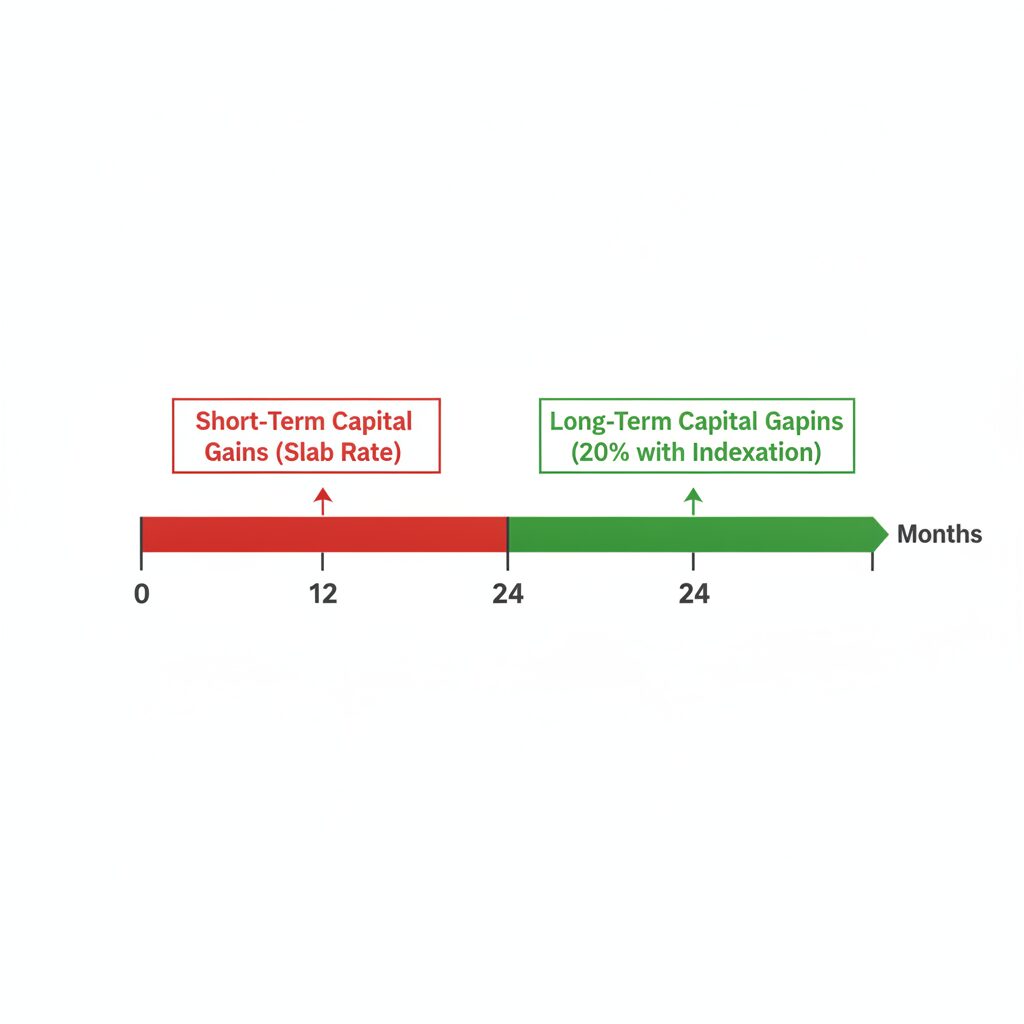
Selling a second home in India triggers a tax event based entirely on your holding period. If you sell a property held for more than 24 months, you deal with Long-Term Capital Gains (LTCG). Anything sold before that 24-month mark is Short-Term Capital Gains (STCG).

For most luxury villa owners in the Sahyadri hills, the goal is to hit the 24-month threshold to access lower tax rates and inflation adjustments. This distinction changes how much of your profit actually stays in your bank account versus going to the Income Tax Department.
The 24-month clock
The tax department views real estate as a long-term asset only after two full years. In practice, if you bought a bespoke villa in Igatpuri in January 2024 and sell it in December 2025, you are in the STCG bracket. If you wait until February 2026, you shift into LTCG.
STCG is simpler but more expensive. The profit is added to your total taxable income for the year and taxed at your applicable income tax slab. For high-net-worth individuals in the 30% bracket, this means a significant chunk of the profit vanishes instantly.
LTCG offers a more favorable path. While the base rate is typically 20%, the real advantage comes from the ability to adjust the purchase price for inflation, which lowers the taxable gain.
How indexation protects your profit
Inflation erodes the value of money. The government acknowledges this through indexation. This process allows you to inflate the original purchase price of your Igatpuri property using the Cost Inflation Index (CII) provided by the government.
Imagine you bought an NA plot for ₹50 Lakhs several years ago and sell it for ₹80 Lakhs. Without indexation, your gain is ₹30 Lakhs. With indexation, that ₹50 Lakhs might be adjusted to ₹65 Lakhs based on inflation. Your taxable gain drops to ₹15 Lakhs.
This is why holding a second home as a legacy asset makes financial sense. The longer you hold, the more the indexation benefit offsets the nominal gain. We often see this when families transition from simple plots to developed gated communities over a decade.
NA plots versus constructed property
Tax treatment remains similar for both, but the calculation of the “cost of improvement” differs. When you sell a constructed villa, you can add the cost of construction, interior fittings, and permanent upgrades to your original purchase price. This increases your cost basis and lowers your tax bill.
For an NA plot, your cost basis is generally the purchase price plus registration and stamp duty. You cannot add “imaginary” value for the appreciation of the surrounding area. The focus here is on the raw land value.
Investors choosing between these two often weigh the tax implications against the ROI. You can see a detailed breakdown in our analysis of NA plot vs apartment ROI in Igatpuri to understand which asset class yields better after-tax returns.
Legal ways to reduce your tax bill
You do not have to pay the full LTCG amount if you reinvest the proceeds. Section 54 and Section 54F of the Income Tax Act are the primary tools for this.
Section 54 allows you to exempt the gain if you use the profit to buy another residential house. This is common for families upgrading from a small weekend home to a larger luxury villa. The new property must be purchased one year before or two years after the sale date.
Section 54F applies when you sell an asset other than a house (like a vacant NA plot) and invest the entire sale proceeds into a residential house. This is a powerful move for those who started with land and now want a permanent residence in the Sahyadri hills.
Another option is the Capital Gains Account Scheme. If you cannot find the right replacement property before the tax filing deadline, you can park the funds in a designated government bank account to maintain your exemption status.
Real-world scenario: The Igatpuri exit
Consider a client who bought a plot in a gated community for ₹40 Lakhs in 2020. By 2026, the property value has risen to ₹75 Lakhs. If they sell now, the nominal gain is ₹35 Lakhs.
After applying the 2026 indexation factors, the adjusted cost might rise to ₹52 Lakhs. This leaves a taxable LTCG of ₹23 Lakhs. At a 20% tax rate, they owe ₹4.6 Lakhs. If they had sold this as a short-term asset in the 30% slab, the tax would have been ₹10.5 Lakhs.
The difference is ₹5.9 Lakhs simply by timing the sale. This highlights why understanding the real cost of owning a second home includes planning the exit strategy from day one.
Managing the legacy transition
For many Mumbai-based professionals, an Igatpuri home is not a flip; it is a family legacy. When passing these properties to the next generation, gift deeds or wills can avoid the immediate trigger of capital gains tax.
Transferring a property as a gift to a relative is generally not considered a “transfer” for capital gains purposes. The receiver inherits the original cost basis of the giver. This keeps the tax liability deferred until the heir eventually decides to sell.
When building a portfolio of plots in Igatpuri, we recommend documenting every single expense—from boundary wall construction to landscaping. These are all deductible costs that reduce your eventual tax burden.
A final warning on tax advice
Tax laws in India change frequently. The interpretations of the Income Tax Department can vary based on how a property is classified (residential vs commercial vs agricultural). This guide provides general information based on current 2026 rules.
It is not professional tax advice. Every financial situation is unique. Always consult a certified Chartered Accountant (CA) to verify your specific calculations before filing your returns or signing a sale deed.
Frequently Asked Questions
Is indexation available for all second homes?
Yes, indexation is available for long-term capital assets held over 24 months. It helps adjust the purchase price for inflation.
What happens if I sell my plot in 18 months?
This is treated as a short-term capital gain. The profit is added to your annual income and taxed at your current slab rate.
Can I avoid tax by buying another plot?
No, Section 54 exemptions generally require the investment to be in a residential house, not vacant land.
Does the 24-month rule apply to NA plots?
Yes, the holding period for land and buildings to qualify as long-term is 24 months in India.
Can I claim the cost of a swimming pool as an improvement?
Yes, permanent improvements to a villa are typically added to the cost of acquisition to reduce capital gains.
What is the current LTCG rate for property in 2026?
The standard rate is 20% with indexation benefits for assets held longer than 24 months.
Do I pay tax if I gift my second home to my children?
No, gifts to linear descendants are generally exempt from capital gains tax at the time of transfer.
How do I use the Capital Gains Account Scheme?
You deposit your gains into a specified bank account before the tax deadline to prove intent to reinvest in a new home.
Secure your family legacy today. Book a private consultation with our property experts to find the perfect Sahyadri retreat with no obligation.